ARCHAIX
Keep the Record
Start with one move, then use this page whenever you need a rule. The complete reference follows the current ruleset, keep-record-2.
Play today's challenge Learn in five moves
Contents
Your first move
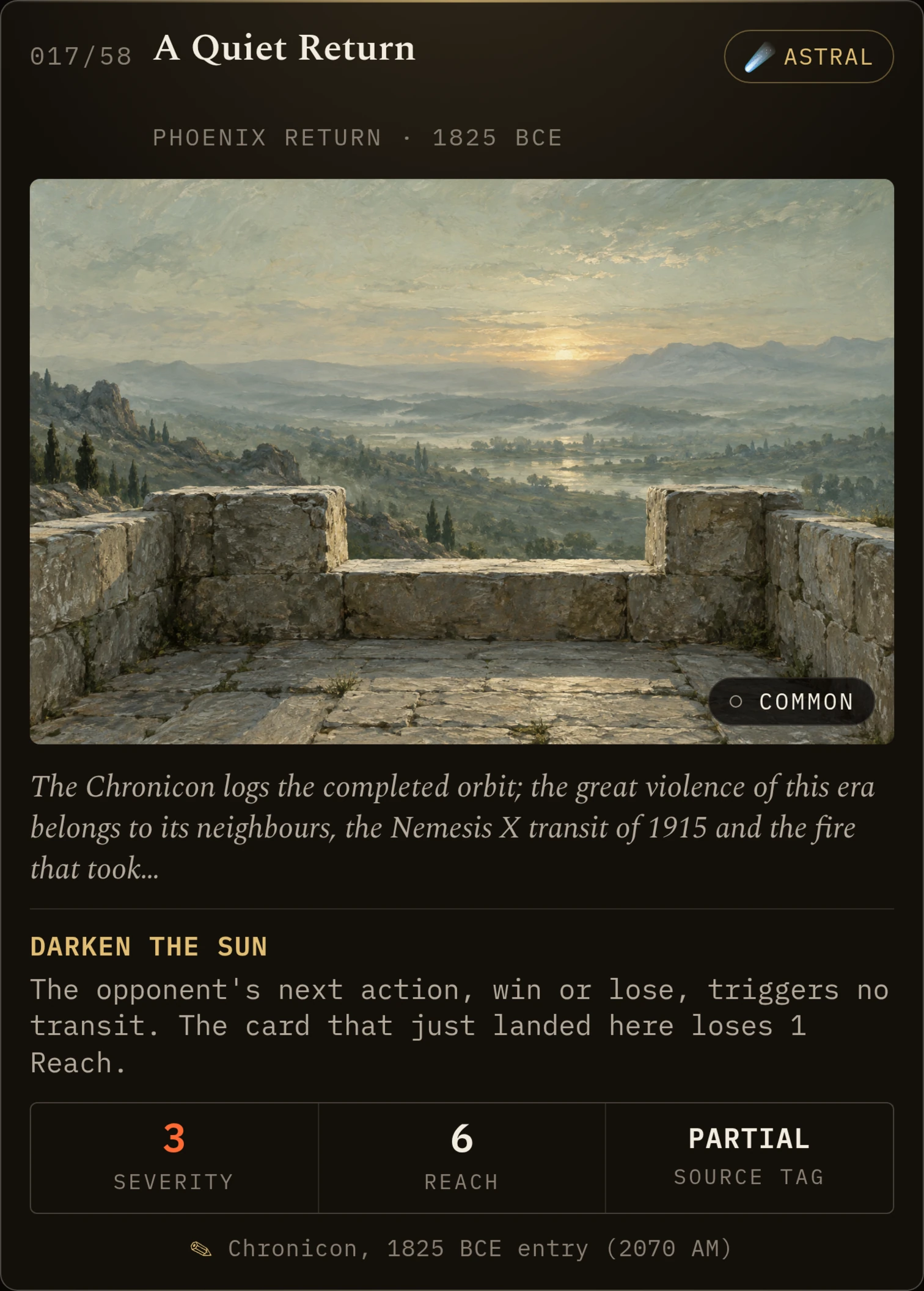
The 1825 BCE return is empty. Play A Quiet Return into it. An empty return is never contested.
Choose the card, choose the lit return, then confirm.
Play this guided moveThe sections below explain each rule when you need it. Start by choosing a card, choosing a lit return and confirming.
What you are doing
You play the Record against the Erasure. These opponents, stats, the type wheel, transits and sealing are game design, not claims from the source books.
Build an Unbroken Record of 6 neighbouring occupied returns, in any game state, to win at the end of the action. Otherwise compare the longest Secured run, then the number of Secured returns. An exact tie goes to the Erasure. Rows continue in chronological order; the ends never join.
The board uses 32 selected Phoenix returns, 2239 BCE to 2040. Its clock counts game steps, not elapsed historical years. The 2106 card is an undealt thematic end marker; playing the 2178 forecast adds two game steps, not two new historical returns.
Setup and zones
The catalogue has 82 cards; all 81 playable cards are available in every shuffled deck. The 2106 terminal marker is not dealt. A game may finish before every card is drawn.
Record and Erasure each receive 5 cards. Record draws its first card before its first action. The hand cap is 7.
The draw pile is shared. Discard is face-up and is not automatically reshuffled. Exile is face-up and never returns. You may archive voluntarily even when a legal play exists. Pass is available only with an empty hand.
A turn
Choose a card, a destination and a target if needed, then preview and confirm. Cancel spends nothing.
Resolution order: placement or contest; successful unsilenced arrival transit; contagion tick; ordinary clock step; permanent sealing; win check; incoming-side draw, unless skipped. The hand cap still applies.
Six neighbouring returns is checked after the entire action, not mid-transit. If both sides qualify, the acting side wins.
Where a card may go
Dated cards belong to the nearest board return; equal-distance ties go to the earlier slot. This is a strategy abstraction, not a claim that an event happened on the return's date.
A dated card contests only its home return. It may take an empty return one position away, two at printed Reach 7–9, or three at printed Reach 10. On-board Reach modifiers affect effects such as Deluge, not placement range or historical dates.
The two intruder planets enter any empty unsealed return. Deep-time cards, dated before the board begins, may take any empty return or contest any enemy return.
You cannot replace your own card. A sealed return is closed permanently.
Winning a contest
Attack is printed Severity, plus 2 for a favourable wheel edge, minus 1 under Wormwood. Defence uses effective on-board Severity, halved and rounded up for Fragmentary, and 2 lower for Vanishing, never below zero.
Forecast defends at zero against an Attested-source attacker until the clock reaches the defender's return.
Strictly higher attack wins; the defeated defender goes to Exile. A tie holds: the attacker goes to Discard and triggers no transit. A losing attack also goes to Discard.
The wheel: Deluge beats Fallout and Contagion; Fallout beats Astral; Astral beats Displacement; Displacement beats Reset and Volcanic. These asymmetric edges are designed bonuses, not a complete rock-paper-scissors wheel or a natural causal law. Other matchups have no wheel bonus.
Source tag versus game state
Source tags describe how this adaptation classifies the cited record: Attested, Partial or Predicted. They are editorial tags, not independent historical verification or a formal classification claimed from the book. On the board these begin as Secured, Fragmentary or Forecast. The Phoenix can secure a return for scoring; it does not change the card's source tag.
Only Secured returns count in the terminal comparison. Fragmentary and Forecast returns can still build an Unbroken Record.
Card prose is an adapted summary. Illustrations are original AI-assisted interpretations, not documentary evidence. Chronicon and Doomsday Chronology are attributed sources, not independent proof of their claims.
The clock and sealed history
The clock takes one ordinary game step after every action. A return seals when the clock is more than 5 positions past it.
A sealed return cannot be contested, weakened, removed or changed by a transit. Moving the clock backwards never reopens it.
Pole Shift moves back one step before the ordinary step: net zero except at clock zero. Extra steps are game timing, not elapsed calendar years.
Every transit, exactly
Darken the Sun (Astral): The opponent's next action — win or lose — triggers no transit, and the card that just landed loses ceil(Severity / 3) Reach.
Slip the Basin (Deluge): Every unsealed card in play whose effective Reach is below clamp(Severity, 4, 9) is exiled — yours included, this card included. Sealed returns survive.
Resurface (Volcanic): Choose one unsealed enemy card anywhere on the board: its Severity drops by 4, to a minimum of 1.
Red Dust (Fallout): Every unsealed Fallout card you hold on the board, this one included, permanently gains 2 Reach.
Vanishing (Vanishing): Exile one unsealed enemy card that is not Mythic. If its game state was Secured, draw a card.
Contagion (Contagion): A contagion starts on this return and walks one return forward after every action, halving the effective Reach of each unsealed card it touches, until it meets a card of Severity equal to or above this card's.
The Age Turns (Reset): Both hands keep their oldest three cards. The clock takes one extra step and the acting side draws a card.
Pole Shift (Displacement): The card that just landed swaps its effective Severity and Reach. The clock steps back once before the ordinary step, never below zero: net zero except at clock zero. Sealed history does not reopen.
Transit (Intruder): The clock advances one extra game step.
The 138-Year Return: Reveal the top three cards of the deck. Each Phoenix return whose own home stands empty and unsealed enters there as yours, Secured for scoring; every other revealed card is discarded. Recruited cards trigger no arrival transit. Their printed source tags do not change.
The Deep: The opponent skips their next draw, and every attack they make is 1 Severity weaker for the rest of the game.
The Great Deluge: Every unsealed card in play that is not Mythic is exiled. Each side then keeps its oldest card in hand, discards the rest, and draws up to two additional cards.
The Fiery Flaming Sword: Every unsealed card in play is exiled, this card included. Both hands return to the deck, the deck is shuffled, and each side is dealt five again. Sealed history is untouched.
The Year the Year Changed: Each side draws up to five cards to the hand cap, then discards its newest cards until its hand is five smaller, never below three. This preserves the oldest three when available; it is attrition, not a choice of five fresh cards.
The Celestial War of Monsters: If both the Phoenix and Nemesis are on the board when this lands, every unsealed card on the two neighbouring returns is exiled and both hands keep only their oldest three. Otherwise it is an ordinary return.
The Empty Spoke: Once, on arrival, the clock's end moves two game steps further away, not two historical returns. The return itself defends no better than any other.
Armageddon · Year 6000: An undealt thematic end marker, not the board's final date. At the clock limit, compare the longest Secured run, then Secured returns held; an exact tie goes to the Erasure.
How a game ends
An Unbroken Record of 6 neighbouring occupied returns, in any game state, wins after the complete action and before the terminal comparison. The acting side has precedence if both sides qualify.
Otherwise the clock limit compares longest Secured run, then Secured held. An exact tie goes to the Erasure.
Empty Spoke delays the limit by 2 game steps, once. The 120-action safety limit uses the same terminal comparison.
Discover through play
Your binder records cards encountered in your hand, on either board, in face-up Discard or Exile, or in a revealed play or archive. The hidden opponent hand and draw pile do not count. Complete a non-training game to discover the undealt 2106 terminal entry.
Discoveries are saved in this browser when storage is available. They never restrict the 81-card shuffle, change stats or daily seeds, or provide an advantage. A discovered prediction remains a prediction.
The full reference is marked as spoilers. Viewing it, the homepage, print or video does not award discoveries. There are no paid packs, rarity odds, trading or multiplayer.
The daily challenge
The same ruleset and catalogue use the same daily seed. The day turns over at 00:00 UTC.
Your first completed daily attempt is kept. Later attempts are practice replays, including in shared results.
Progress is browser-local. There is no account, cross-device sync or leaderboard.
Inspired by Jason Breshears' Chronicon and Doomsday Chronology. Summaries and source tags are editorial, not independent verification. Stats, transits, sealing and opponents are game design. The original AI-assisted illustrations are interpretations, not documentary evidence.